




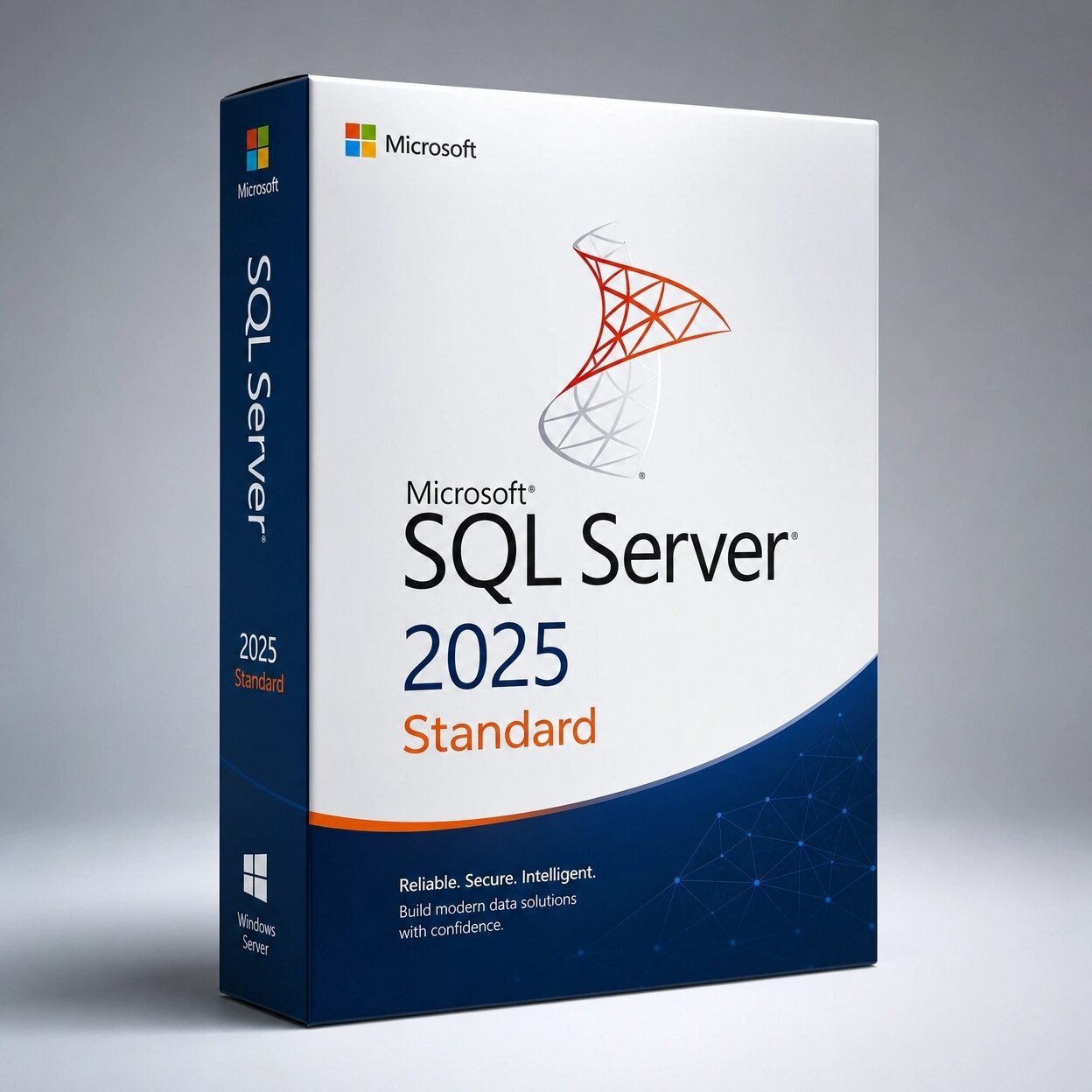
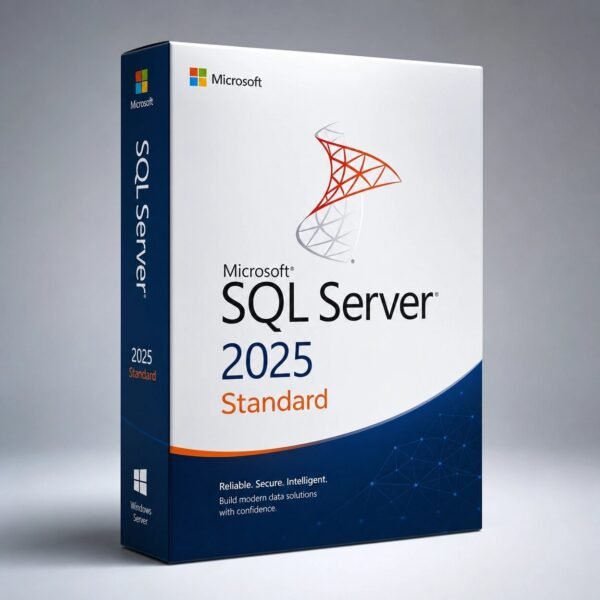
Microsoft SQL Server 2025 Standard
CAD $ 240.00
A genuine perpetual Microsoft database license for businesses needing a powerful, secure, and scalable data platform with no subscription required.
- Includes intelligent query processing, enhanced security, Azure hybrid integration, high availability, and built-in machine learning
- Covers 16 cores ideal for ERP, CRM, web apps, reporting, and analytics
- Full Microsoft licensing compliance for SQL Server 2025 Standard
- Delivery: License key sent by email within minutes
- Lifetime license one payment, forever
- Guarantee: 100% satisfaction & money-back guarantee
Genuine Microsoft license — activated on Microsoft’s own servers
- Instant delivery: your product key, official download link and step-by-step activation guide arrive by email within minutes of payment — 24/7, USA & Canada.
- Lifetime license: pay once, activate forever. No subscription, no renewal fees, no expiry.
- 100% genuine & legal: every key is sourced through authorized supply chains and verified before it reaches your inbox.
- Money-back guarantee: 30-day refund policy plus a lifetime activation warranty — if a key ever fails, we replace it free.
- Secure checkout: Visa, Mastercard, Apple Pay, Google Pay, PayPal and Interac e-Transfer.
- Real human support: licensing and activation help across North American time zones.
How it works: 1) Add to cart and pay securely → 2) Check your inbox for the key and download link → 3) Install and activate with the included guide. Need help? See our activation guides or contact us.
Microsoft SQL Server 2025 Standard – Genuine Perpetual License
Microsoft SQL Server 2025 Standard is a genuine perpetual license for Microsoft’s industry-leading relational database management system the platform on which organizations across the USA and Canada run the data infrastructure their businesses depend on. Line-of-business application databases, ERP and CRM backends, web application data layers, reporting and analytics environments, hybrid cloud data workloads, and developer platforms.
SQL Server 2025 Standard is the version of that platform engineered for the performance, security, and scalability requirements of the current decade with next-generation intelligent query processing, zero-trust-aligned security features, enhanced high availability, native Azure cloud integration, and integrated machine learning capabilities built directly into the database engine.
This is a one-time purchase. No subscription. No annual renewal. No expiration. Your license key is delivered by email within minutes of purchase and activates the full 64-bit SQL Server 2025 Standard installer downloaded directly from Microsoft.
What Is Microsoft SQL Server 2025 Standard?
Microsoft SQL Server is the relational database management system on which organizations have built their data infrastructure for decades. It is the platform that stores, manages, retrieves, and protects the data that business applications depend on from the transaction records and customer data that line-of-business applications read and write, to the analytical datasets that business intelligence tools query, to the machine learning models that run inside the database engine itself.
SQL Server 2025 Standard is the edition designed for the large majority of real-world SQL Server deployments: physical database servers and virtualized database instances running traditional workloads, departmental databases, web application backends, reporting environments, and hybrid cloud data workloads where the advanced high availability and unlimited virtualization rights of Enterprise edition are not required.
Standard delivers the complete SQL Server 2025 database engine every security feature, every performance improvement, every developer tool, every management capability, and every hybrid cloud integration introduced in the 2025 release with a per-instance core limit of 24 cores and 128 GB of buffer pool RAM. For the large majority of SMB, departmental, and non-mission-critical production database deployments, Standard is the correct and more cost-effective edition.
SQL Server 2025 Standard is licensed using Microsoft’s core-based licensing model. The license delivered covers 16 cores the standard coverage for SQL Server 2025 Standard deployments. Servers with more than 16 physical or virtual cores actively running SQL Server require additional core pack licenses to cover every active core.
What Is New in SQL Server 2025 Standard
Next-Generation Intelligent Query Processing. SQL Server 2025 Standard delivers the most significant query processing improvements in years, with the database engine automatically adapting query execution plans based on runtime feedback and workload characteristics. Rather than relying on static query plans compiled at execution time, the intelligent query processing framework in SQL Server 2025 monitors actual execution behavior and adjusts plans dynamically to eliminate the performance regressions and suboptimal plans that have historically required manual index tuning or query hint intervention.
The result is consistently faster query performance across mixed workloads reporting queries, transactional workloads, and analytical queries without requiring DBA intervention for individual queries. Improved data compression reduces the storage footprint of database files and indexes while simultaneously accelerating data retrieval by reducing the volume of data read from storage into memory. Faster database recovery minimizes the time between a failure event and the database returning to a consistent, accessible state, reducing the operational impact of unexpected interruptions.
Advanced Security Architecture. SQL Server 2025 Standard introduces significant advances in the encryption, access control, and data privacy capabilities built into the database engine. Always Encrypted with updated secure enclaves extends the original Always Encrypted feature which protected sensitive column data from database administrators by encrypting it in a way that the server never sees the plaintext with support for richer query operations on encrypted data through hardware-backed secure enclaves.
Encrypted columns can now participate in range comparisons, pattern matching, and join operations that were not possible with the original Always Encrypted implementation, without exposing the plaintext data to the server or to administrators. Dynamic Data Masking applies real-time masking rules to query results, replacing sensitive data values credit card numbers, national identification numbers, email addresses, and similar fields with masked representations for users and applications that do not have the privilege to see the actual values, without modifying the stored data itself.
Row-Level Security enforces access control policies at the row level inside the database engine, ensuring that queries against a table automatically filter results to the rows that the connecting user or application is permitted to see removing the requirement to implement data filtering logic in every application that accesses the table.
Seamless Azure and Hybrid Cloud Integration. SQL Server 2025 Standard is engineered for the hybrid environments that describe the reality of most enterprise data deployments on-premises database servers running alongside cloud workloads, with data and management spanning both environments. Azure integration enhancements in SQL Server 2025 enable on-premises SQL Server instances to connect to Microsoft Azure for hybrid data workloads, cloud-based backup and disaster recovery, and unified management through Azure Arc.
Azure Arc-enabled SQL Server 2025 instances appear as managed resources in the Azure portal alongside cloud databases, enabling unified monitoring, policy enforcement, security posture management through Microsoft Defender for SQL, and governance across on-premises and cloud database infrastructure from a single control plane without requiring workloads to be migrated to Azure.
Improved big data extensions enable SQL Server 2025 to work with large and complex datasets more efficiently, with expanded support for external data sources and data virtualization that allows SQL Server to query data stored in Azure Data Lake, Azure Blob Storage, and other external sources without moving that data into SQL Server itself. Comprehensive API compatibility ensures that SQL Server 2025 integrates with modern application frameworks, development platforms, and data engineering tools at scale.
Enhanced High Availability and Disaster Recovery. SQL Server 2025 Standard delivers meaningful improvements to the high availability and disaster recovery capabilities available in the Standard edition. Always On Availability Groups receive enhanced automatic failover capabilities that reduce the time between a primary replica failure and the promotion of a secondary replica to primary improving the recovery time objective for databases protected by Availability Groups without requiring manual administrator intervention.
Advanced failover clustering improvements increase the reliability and resilience of Windows Server Failover Cluster deployments running SQL Server 2025, with improved handling of transient network and storage interruptions that in earlier versions could trigger unnecessary failover events. Modernized backup and restore capabilities deliver faster backup completion, more reliable backup verification, and reduced restore times — improvements that directly reduce the recovery point objective and recovery time objective for databases that rely on backup-based recovery rather than high availability replicas.
Developer-Friendly Platform with Integrated Machine Learning. SQL Server 2025 Standard includes a complete set of development tools and an integrated machine learning runtime that allows R and Python workloads to execute directly inside the database engine. SQL Server Machine Learning Services enables data scientists and application developers to run R and Python scripts as T-SQL stored procedures, with the script executing inside an isolated extensibility framework that has direct access to in-database data eliminating the data movement overhead that external machine learning platforms require.
Models trained externally can be stored in the database and scored in real time against incoming data using the PREDICT function, enabling low-latency machine learning inference without round-tripping data to an external service. Updated SQL Server Data Tools streamline the development, testing, and deployment of database projects, with improved schema comparison, source control integration, and deployment pipeline support.
Native support for JSON, XML, and modern semi-structured data formats allows SQL Server 2025 to serve as the data layer for applications built on modern API architectures without requiring a separate document store. Support for spatial data types, full-text search, and graph database capabilities is included, making SQL Server 2025 Standard a versatile data platform capable of supporting a wide range of application data models beyond traditional relational schemas.
Comprehensive Management and Monitoring Tools. SQL Server 2025 Standard includes a complete suite of database management, monitoring, and optimization tools. SQL Server Management Studio provides a comprehensive graphical interface for administering SQL Server instances, managing databases, executing queries, reviewing execution plans, and configuring server properties.
The Database Engine Tuning Advisor analyzes query workloads against a database and recommends index, indexed view, and partitioning changes that would improve query performance for that workload providing actionable optimization recommendations without requiring deep query tuning expertise.
SQL Server Profiler enables administrators to trace and monitor SQL Server events in real time, capturing the queries, stored procedure calls, and login events that pass through the server for performance analysis and troubleshooting. Extended Events provides a lightweight, highly configurable event monitoring framework that captures detailed diagnostic information about SQL Server internal operations with minimal performance overhead the preferred approach for production performance monitoring and incident investigation.
SQL Server 2025 Standard vs Enterprise Which Edition Do You Need?
SQL Server 2025 Standard and Enterprise share the same core database engine the same query processor, the same storage engine, the same security features, the same Azure integration, and the same developer tools. There is no fundamental database capability present in Enterprise that is absent in Standard as a function of the installed software itself.
The differences between the two editions are in scale limits and advanced high availability capabilities. Standard edition is capped at 24 cores and 128 GB of buffer pool RAM per instance. For the large majority of SQL Server deployments — departmental databases, SMB production workloads, web application backends, reporting environments, and development and test instances these limits are never approached, and Standard is the correct and substantially more cost-effective choice.
Enterprise edition removes the core and memory limits entirely, allowing a single SQL Server instance to use all available cores and memory on the host server. It adds advanced in-memory OLTP capabilities for high-throughput transactional workloads, advanced columnstore indexes for large-scale analytical queries, online index operations that allow index maintenance without taking the affected table offline, and advanced Always On features including readable secondary replicas for read workload offload and distributed availability groups for geographically dispersed deployments. Enterprise also includes unlimited virtualization rights on licensed hosts meaning a single Enterprise license covers all virtual machines on a licensed physical server rather than requiring per-instance core licensing for each VM.
The practical selection rule is straightforward. If a SQL Server instance will require more than 24 cores or more than 128 GB of buffer pool RAM, Enterprise is required. If a deployment requires advanced in-memory OLTP, readable secondary replicas, or online index operations for zero-downtime maintenance windows on large tables, Enterprise should be evaluated. For all other deployments which describes the majority of real-world SQL Server workloads Standard is the appropriate and more cost-effective edition.
Core-Based Licensing Explained
SQL Server 2025 uses a core-based licensing model. Every physical or virtual core on the server that is running SQL Server must be licensed. This license covers 16 cores sufficient for the large majority of SQL Server Standard deployments running on modern server hardware within the Standard edition’s 24-core per-instance limit.
For servers with more than 16 physical cores where SQL Server is running, additional core pack licenses must be purchased to cover every active core. The minimum licensing requirement is 4 cores per physical processor, regardless of how many cores the processor actually has a processor with 2 physical cores still requires a 4-core minimum license.
SQL Server 2025 Standard also supports an alternative Server plus Client Access License model for smaller environments where user-based or device-based access licensing is more cost-effective than core-based licensing. Under this model, the server requires a single SQL Server 2025 Standard Server license, and each user or device that accesses SQL Server requires a SQL Server 2025 CAL.
The Server plus CAL model is subject to limits on the number of cores that can be used — it is appropriate for environments with small numbers of users or devices accessing a lightly loaded database server, and is not available for internet-facing workloads where the number of users is not controlled.
Who Is Microsoft SQL Server 2025 Standard For?
Small and medium businesses running line-of-business applications, ERP systems, CRM platforms, accounting software, and custom business applications whose data is stored in SQL Server where a single database server or a small number of database instances covers the workload requirements and the Standard edition limits are never approached.
Web application and e-commerce platforms where SQL Server serves as the relational database backend for web applications, content management systems, customer-facing portals, and transaction processing systems where the performance improvements and security enhancements in SQL Server 2025 directly improve application responsiveness and data protection.
Business intelligence and reporting environments where SQL Server 2025 Standard serves as the data platform for SQL Server Reporting Services, SQL Server Analysis Services, and data warehouse workloads that feed dashboards, scheduled reports, and ad hoc analytical queries.
Organizations adopting machine learning and data science capabilities where the integrated R and Python execution in SQL Server 2025 Machine Learning Services allows predictive models and analytical workloads to run directly against in-database data without requiring a separate machine learning platform or data export pipeline.
IT departments upgrading from SQL Server 2019 or SQL Server 2022 Standard who want the intelligent query processing improvements, security enhancements, Always On improvements, and Azure Arc integration of the 2025 release for their existing Standard-edition database fleet without changing the edition or the licensing model.
Organizations adopting hybrid cloud architectures where on-premises SQL Server 2025 Standard instances are Azure Arc-enabled, gaining unified Azure portal management, Azure Monitor integration, Microsoft Defender for SQL security posture management, and Azure Backup for database backup alongside cloud database resources without migrating workloads to Azure.
Development and test environments where the full SQL Server 2025 production feature set is required for representative application testing, staging, and quality assurance where Standard edition licensing covers the complete database engine at a significantly lower cost than Enterprise.
Branch offices and remote site database servers running local application databases, local reporting databases, or locally cached data from central database servers where a Standard edition instance on a branch server covers the full workload requirements without Datacenter or Enterprise licensing costs.
How to Install and Activate Microsoft SQL Server 2025 Standard
Step 1 — After purchase, your genuine 25-character Microsoft SQL Server 2025 Standard product key is delivered to your email inbox within minutes. Check your spam folder if it does not appear in your primary inbox.
Step 2 — Go to Microsoft’s official Evaluation Center at microsoft.com and download the SQL Server 2025 Standard 64-bit ISO file directly. No third-party download sources are required or recommended.
Step 3 — Mount the ISO or copy the installation files to installation media. Run the SQL Server 2025 setup program and follow the installation wizard. When prompted to select an installation type, choose a new installation of SQL Server 2025. Select the features you need Database Engine Services, SQL Server Replication, Full-Text and Semantic Extractions for Search, Reporting Services, Analysis Services, Integration Services, and Machine Learning Services with R and Python are all available as individually selectable components.
Step 4 — When prompted for a product key during setup, enter your 25-character SQL Server 2025 Standard key. Complete the remaining configuration steps instance configuration, service account configuration, database engine configuration including authentication mode and data directories, and any additional feature configuration. Complete the installation wizard.
Step 5 — Activation completes automatically during setup for systems with internet access. For environments without internet access, telephone activation and offline activation options are available through the setup wizard.
Full step-by-step installation and activation instructions are included with every order. Our support team is available 24 hours a day, 7 days a week if you need assistance at any stage of the installation or activation process.
Minimum System Requirements for Microsoft SQL Server 2025 Standard
Processor: 1.4 GHz 64-bit processor minimum; 2.0 GHz or faster recommended for production environments. Multi-core processors are recommended for workloads with concurrent users. x64 architecture is required — 32-bit is not supported.
RAM: 2 GB minimum; 8 GB or more recommended for production deployments. Memory requirements scale with database size, number of concurrent connections, and workload complexity. In-memory features and machine learning workloads benefit significantly from additional RAM beyond the minimum.
Storage: 8 GB minimum available space for the SQL Server installation. Additional storage is required for database files, transaction log files, tempdb, backup files, and optional features such as Full-Text Search indexes. Production deployments should provision storage based on projected database growth and backup retention requirements.
Operating System: Windows Server 2019 or later for production server deployments. Windows 11 64-bit is supported for development and test scenarios. x64 architecture is required on all supported operating systems.
Additional Requirements: .NET Framework 4.8 or later is required and is installed automatically if not already present. Microsoft ODBC Driver for SQL Server and Microsoft OLE DB Driver for SQL Server are included with the SQL Server installer. Internet access is required for online activation and for Azure-connected features including Azure Arc integration and Azure Backup.
Production database servers should substantially exceed the minimum requirements. Microsoft recommends ECC RAM for production database servers, NVMe or SSD storage for database and log files on latency-sensitive workloads, and dedicated storage volumes for database files, transaction log files, tempdb, and backup files to maximize I/O throughput and isolation.
Is this a genuine Microsoft SQL Server 2025 Standard license?
Yes. Every key we sell is an authentic Microsoft product license genuine, perpetual, and activated directly on Microsoft's servers. There are no shared keys, workarounds, or grey-market codes of any kind.
Is SQL Server 2025 Standard a one-time purchase?
Yes. SQL Server 2025 Standard is a perpetual license. You pay once and own it permanently no annual subscription, no renewal fees, no expiration date. The license remains valid for the full supported lifetime of the product.
How many cores does this license cover?
This license covers 16 cores using Microsoft's core-based licensing model. For servers with more than 16 physical or virtual cores actively running SQL Server, additional core pack licenses must be purchased to cover every active core. The minimum requirement is 4 cores per physical processor.
What is the difference between Standard and Enterprise?
Both editions include the complete SQL Server 2025 database engine, security features, developer tools, and Azure integration. Standard is capped at 24 cores and 128 GB of buffer pool RAM per instance. Enterprise removes those limits and adds advanced in-memory OLTP, readable secondary replicas, online index operations, and unlimited virtualization rights. For the majority of SMB and departmental workloads, Standard is the correct and more cost-effective choice.
Does SQL Server 2025 Standard support machine learning?
Yes. SQL Server 2025 Standard includes Machine Learning Services, which allows R and Python scripts to execute directly inside the SQL Server engine as T-SQL stored procedures. Predictive models can be stored in the database and scored in real time using the PREDICT function — without exporting data to an external machine learning platform.
Does SQL Server 2025 Standard work with Azure?
Yes. SQL Server 2025 Standard includes enhanced Azure integration for hybrid cloud environments. On-premises SQL Server 2025 instances can be Azure Arc-enabled to appear as managed resources in the Azure portal, gaining Azure Monitor integration, Microsoft Defender for SQL, Azure Policy governance, and Azure Backup without migrating workloads to Azure.
Can I upgrade from SQL Server 2019 or SQL Server 2022?
Yes. In-place upgrade from SQL Server 2022 Standard and SQL Server 2019 Standard to SQL Server 2025 Standard is supported. Microsoft recommends testing in a non-production environment before upgrading production database servers.
What operating systems does SQL Server 2025 Standard support?
SQL Server 2025 Standard supports Windows Server 2019 and later for production server deployments. Windows 11 64-bit is supported for development and test scenarios. x64 architecture is required 32-bit operating systems are not supported.
Does this license work in Canada? Y
es. Our licenses are valid across the USA and Canada. Your product key is delivered by email within minutes of purchase and activates directly on Microsoft's global activation servers with no region restrictions for USA and Canadian customers.
How soon will I receive my product key after purchase?
Orders are delivered within minutes of payment confirmation, 24 hours a day, 7 days a week. Your email includes the product key and full installation instructions.
What if my product key does not activate?
Contact our support team at any time. Every license we sell is backed by a lifetime warranty and money-back guarantee. If your key does not activate for any reason, we will resolve the issue or provide a replacement at no cost. CONTACT US
You May Be Interested In…


Reviews
There are no reviews yet