




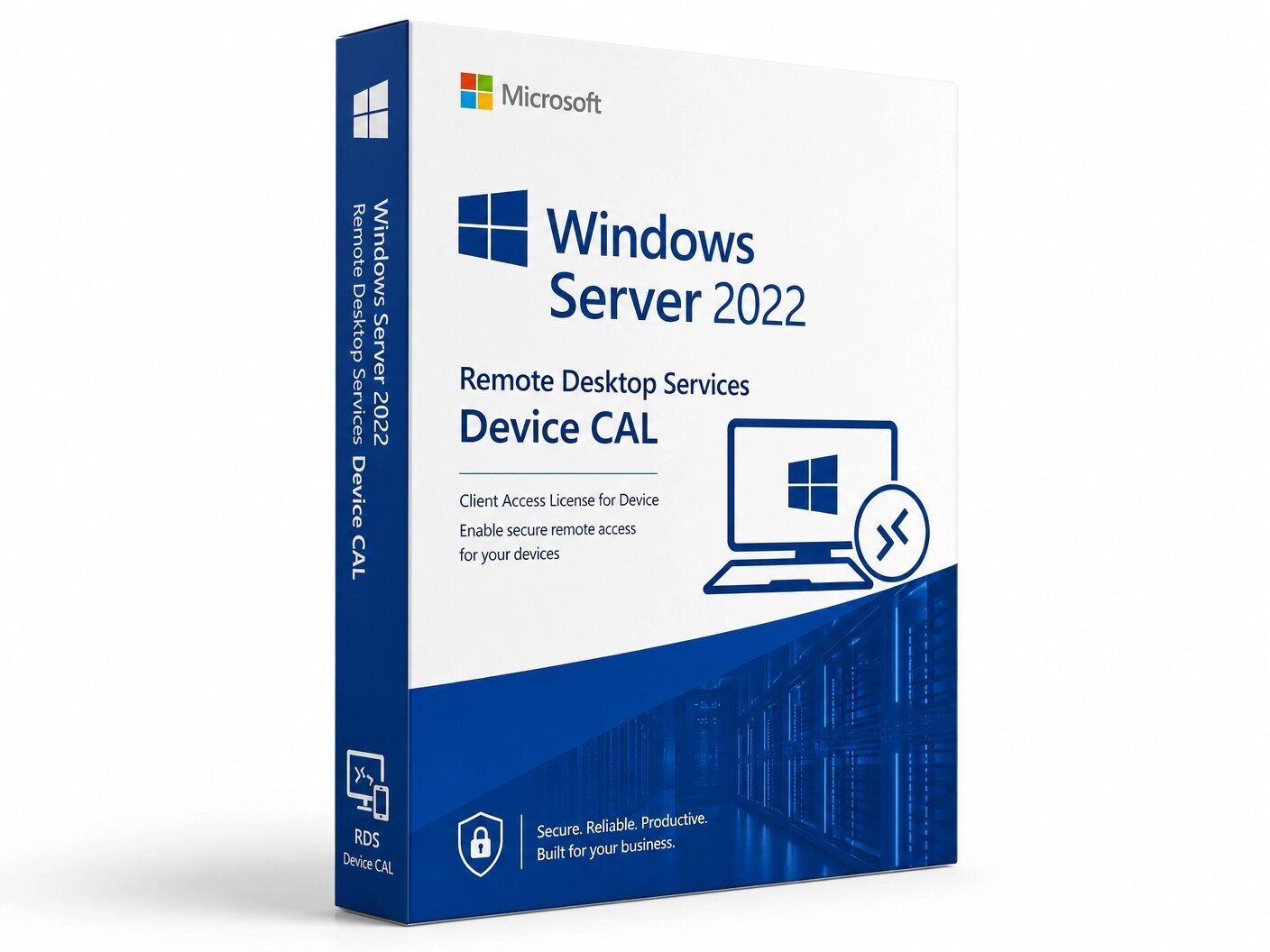
Microsoft Windows Server 2022 Remote Desktop Services
CAD $ 78.00
A genuine Microsoft license granting one device unlimited user access to Windows Server 2022 Remote Desktop Services.
- Device-based license multiple users, one device
- Full Microsoft licensing compliance for Windows Server 2022 RDS
- Must be used alongside a base Windows Server CAL
- Delivery: License key sent by email within minutes
- Lifetime license one payment, forever
- Guarantee: 100% satisfaction & money-back guarantee
Genuine Microsoft license — activated on Microsoft’s own servers
- Instant delivery: your product key, official download link and step-by-step activation guide arrive by email within minutes of payment — 24/7, USA & Canada.
- Lifetime license: pay once, activate forever. No subscription, no renewal fees, no expiry.
- 100% genuine & legal: every key is sourced through authorized supply chains and verified before it reaches your inbox.
- Money-back guarantee: 30-day refund policy plus a lifetime activation warranty — if a key ever fails, we replace it free.
- Secure checkout: Visa, Mastercard, Apple Pay, Google Pay, PayPal and Interac e-Transfer.
- Real human support: licensing and activation help across North American time zones.
How it works: 1) Add to cart and pay securely → 2) Check your inbox for the key and download link → 3) Install and activate with the included guide. Need help? See our activation guides or contact us.
Windows Server 2022 Remote Desktop Services (RDS) Device CAL – Genuine License
Buy Windows Server 2022 RDS Device CAL | Fast Email Delivery | USA & Canada
A Windows Server 2022 Remote Desktop Services Device CAL (Client Access License) is the Microsoft-required license that legally entitles a specific physical device to connect to Remote Desktop Services on a Windows Server 2022 host for any number of users who share that device, as many times as needed.
If your organization uses Remote Desktop Services to deliver hosted desktops, published applications, or centralized remote access to Windows Server 2022, every device used to make those connections requires both a base Windows Server 2022 User or Device CAL and a Windows Server 2022 RDS Device CAL. The RDS Device CAL is the additional license that specifically covers the Remote Desktop Services session initiated from that device — it is a legal requirement enforced during Microsoft licensing audits and cannot be substituted with any other license type.
The license key delivered by MMKeys is a genuine Microsoft RDS Device CAL for Windows Server 2022, delivered to your email inbox within minutes of purchase, backed by our lifetime warranty and money-back guarantee.
What Is a Windows Server 2022 RDS Device CAL?
Remote Desktop Services is the Windows Server role that enables multiple users to connect simultaneously to a Windows Server 2022 host and run applications or full desktop sessions in a centralized, server-hosted environment. It is the platform behind virtual desktop infrastructure, remote application delivery, thin-client computing, shared workstation environments, kiosk terminals, and branch office connectivity to centralized server resources.
Microsoft licenses access to Remote Desktop Services through Client Access Licenses. Without valid RDS CALs installed and issued through an RDS License Server, Windows Server 2022 operates in a grace period of 120 days before Remote Desktop Services begins refusing connections from users beyond the two built-in administrative sessions that are always available for server management.
A Device CAL licenses a specific physical endpoint not a person. One Windows Server 2022 RDS Device CAL covers a single device from which any number of users may connect to Remote Desktop Services. There is no limit on how many people use that licensed device, and no limit on how many sessions originate from it across different users throughout the day. The license travels with the device, not with the individuals who sit in front of it.
This makes the Device CAL the correct and most cost-effective choice for shared workstations, kiosk terminals, call center stations, manufacturing floor endpoints, and any environment where multiple users take turns accessing Remote Desktop Services from the same physical machine.
RDS Device CAL vs. RDS User CAL — Which Do You Need?
Windows Server 2022 Remote Desktop Services can be licensed either per device or per user. The two CAL types cannot be mixed on the same RDS License Server an organization must choose one model for a given RDS deployment.
RDS Device CAL licenses a specific physical device. Any number of users may connect to Remote Desktop Services from that licensed device. One CAL per endpoint, regardless of how many individuals use it. This is the right choice for shared workstations, kiosk terminals, reception desks, call center stations, classroom computers, manufacturing floor endpoints, shift-work environments, and any situation where multiple users share a device and the number of devices is lower than the number of users.
RDS User CAL licenses a named individual. That person may connect from any number of devices. One CAL per person, regardless of how many endpoints they use. This is the right choice for remote workers connecting from home and the office, employees who use multiple devices throughout their workday, and environments where the number of users is smaller than the total number of devices they collectively use.
The practical selection rule: count your devices and count your users. License whichever number is smaller. For shared terminal environments, call centers, kiosk deployments, and shift-based workplaces, Device CALs are almost always more cost-effective. For flexible working environments with one person per device or users connecting from multiple endpoints, User CALs are typically the better fit.
Who Needs Windows Server 2022 RDS Device CALs?
Call centers and customer service environments where agents share workstations across shifts, multiple employees use the same physical terminals throughout the day, and the number of desks and endpoints is significantly smaller than the total headcount. One Device CAL per terminal covers every agent who sits at that station regardless of how many shift rotations occur.
Manufacturing and warehouse floor environments where a small number of shared terminals are mounted at workstations, conveyor lines, or packing stations for multiple workers to access production management applications, inventory systems, or time-tracking tools hosted on Windows Server 2022 via Remote Desktop Services. Device CALs license the terminal, not the rotating workforce using it.
Kiosk and self-service terminal deployments where a locked-down endpoint runs a published Remote Desktop Services application in kiosk mode, accessed by an unknown or rotating population of users. A single Device CAL per kiosk terminal covers all access regardless of who uses the terminal or how frequently.
Classroom and computer lab environments schools, universities, training centers, and technical labs where the same physical computers are used by different students across multiple sessions, periods, or classes throughout the day and week. Device CALs eliminate the need to license every individual student separately when the number of lab computers is smaller than the student population using them.
Reception desks and shared office workstations where a front-of-house workstation is used by receptionists, administrators, or rotating staff members who all access Windows Server 2022 hosted applications or desktops through Remote Desktop Services from the same physical device.
Healthcare and clinical environments where shared workstations in examination rooms, nursing stations, or clinical areas are accessed by multiple clinicians, nurses, or administrative staff throughout the day, all connecting to centralized clinical applications or electronic health record systems hosted on Windows Server 2022 via RDS.
Thin-client device fleets where organizations have deployed dedicated thin-client hardware (devices with minimal local compute that connect exclusively to RDS sessions for all computing tasks) and the number of thin-client devices is smaller than the number of users who use them across different shifts or time periods.
Organizations upgrading from Windows Server 2019 to Windows Server 2022 RDS CALs are version-specific. Windows Server 2019 RDS Device CALs are not valid for connections to a Windows Server 2022 RDS host. Organizations upgrading their RDS infrastructure to Windows Server 2022 must acquire Windows Server 2022 RDS Device CALs to remain compliant.
What Is New and Important About Windows Server 2022 RDS
Windows Server 2022 Remote Desktop Services builds on the foundations of Windows Server 2019 RDS with improvements across security, transport performance, and management that benefit Device CAL deployments directly.
Security hardening by default is one of the most significant practical improvements in Windows Server 2022 for RDS environments. The default TLS configuration is strengthened, weak cipher suites are disabled at the OS level, and enhanced credential protection reduces the exposure of authentication credentials during Remote Desktop sessions. For shared-device environments where multiple users authenticate to RDS from the same terminal throughout the day, the strengthened default security posture reduces the credential theft risk that shared authentication scenarios can introduce without requiring post-installation security configuration by the administrator.
Transport layer improvements in Windows Server 2022 enhance the responsiveness of Remote Desktop sessions over variable-quality network connections. For thin-client environments, manufacturing floor terminals, and shared workstations on congested network segments, the transport improvements deliver a more consistent session experience compared to Windows Server 2019 hosts under similar network conditions.
SMB over QUIC in Windows Server 2022 enables secure access to file shares without VPN infrastructure complementing RDS deployments where shared-device users need both Remote Desktop application sessions and access to shared file resources, without requiring that both the RDS traffic and the file share traffic traverse a traditional VPN.
Windows Admin Center management improvements in Windows Server 2022 provide a modern browser-based interface for managing RDS roles, Session Hosts, and licensing configuration reducing the administrative overhead of maintaining RDS infrastructure in environments with multiple shared-device deployments across different sites or departments.
Azure Virtual Desktop hybrid integration in Windows Server 2022 makes it easier to extend on-premises RDS deployments into Azure for scenarios where some shared device locations connect to on-premises Session Hosts and overflow capacity or remote-site access is handled through Azure-hosted sessions, managed from a unified control plane.
Licensing Note – What CALs Are Required for RDS
Running Remote Desktop Services on Windows Server 2022 legally requires two separate CAL types for every connecting device, purchased separately from the server operating system license:
Windows Server 2022 Device CAL — the base access license required for any device accessing any service on a Windows Server 2022 server. This is required regardless of whether Remote Desktop Services is involved. If you have already licensed your devices with Windows Server 2022 User CALs for the individuals using them, those User CALs satisfy the base access requirement, but the RDS Device CAL is still required on top for the Remote Desktop Services session specifically.
Windows Server 2022 RDS Device CAL — the additional Remote Desktop Services-specific license required on top of the base CAL, specifically covering devices initiating Remote Desktop Services sessions. This is what the license from MMKeys provides.
Both CAL types are required. The RDS Device CAL does not replace the base Windows Server Device CAL — it adds to it. The Windows Server 2022 server operating system license covers the server itself. The base CAL covers general server access. The RDS Device CAL covers the Remote Desktop Services session specifically.
CALs are version-specific: Windows Server 2019 RDS Device CALs are not valid for access to Windows Server 2022 RDS. Windows Server 2022 RDS Device CALs are backward-compatible — they can be used for access to older Windows Server RDS versions.
RDS CALs are managed and tracked by an RDS License Server role installed on a Windows Server in the environment. The License Server issues CAL tokens to connecting client devices and tracks CAL consumption against the installed CAL count. Deploying and pointing your Session Hosts to an RDS License Server is a required step in any compliant RDS deployment.
Key Details at a Glance
- License type: Windows Server 2022 Remote Desktop Services Device CAL
- Per-device coverage: One CAL licenses one physical device for any number of users connecting from it
- Version compatibility: Valid for Windows Server 2022 RDS; backward-compatible with older RDS versions
- CAL model: Device CAL — licenses the endpoint, not the individual user
- Additional requirement: Base Windows Server 2022 Device CAL also required per device (sold separately)
- Grace period without CALs: 120 days from RDS role installation before connections are refused
- License management: Managed via RDS License Server role on Windows Server
- Delivery: Genuine Microsoft license delivered by email within minutes of purchase
- Warranty: Lifetime warranty and money-back guarantee on every MMKeys order
- Support: 24/7 support available
How to Deploy Windows Server 2022 RDS Device CALs
Step 1 — Purchase and receive your RDS Device CALs. Your license key arrives by email within minutes of payment confirmation at MMKeys. Check your spam folder if it does not appear in your primary inbox.
Step 2 — Install the Remote Desktop Licensing role. On a Windows Server 2022 server in your environment, open Server Manager, add the Remote Desktop Licensing role service, and complete the role installation. This server becomes your RDS License Server.
Step 3 — Activate the License Server. Open the Remote Desktop Licensing Manager console, right-click your server, and select Activate Server. Follow the activation wizard online activation completes in seconds; telephone activation is available for environments without internet access.
Step 4 — Install your RDS Device CALs. In the Remote Desktop Licensing Manager, right-click your activated License Server and select Install Licenses. Enter your license key when prompted, select Windows Server 2022 as the product version and RDS Per Device CAL as the license type, and complete the installation.
Step 5 — Configure Session Hosts to use your License Server. On each RDS Session Host, open Group Policy or Local Group Policy and navigate to Computer Configuration > Administrative Templates > Windows Components > Remote Desktop Services > Remote Desktop Session Host > Licensing. Set the licensing mode to Per Device and specify your License Server address.
Step 6 — Verify. Open Remote Desktop Licensing Diagnoser on your Session Hosts to confirm that Device CALs are being issued correctly to connecting devices and that no licensing warnings are present. The first time each device connects after CAL installation, it is issued a temporary CAL token that is upgraded to a permanent token on subsequent connections.
Full step-by-step activation instructions are included with every MMKeys order. Our support team is available 24 hours a day, 7 days a week if you need assistance at any stage.
Is this a genuine Windows Server 2022 RDS Device CAL?
Yes. Every license sold by MMKeys is an authentic Microsoft product license. There are no shared keys, workarounds, or grey-market codes. Your RDS Device CAL installs and activates through Microsoft's official Remote Desktop Licensing infrastructure.
Do I need both a base Windows Server CAL and an RDS Device CAL?
Yes. Both are required. The Windows Server 2022 Device CAL covers general server access for the device. The RDS Device CAL covers the Remote Desktop Services session specifically. Both must be licensed for every device connecting via RDS. The base Windows Server 2022 Device CAL is available separately at MMKeys.
How many users can share one RDS Device CAL?
Unlimited. A Device CAL licenses a specific physical endpoint, and any number of individuals may use that device to connect to Remote Desktop Services. There is no user limit associated with a Device CAL — it covers all access originating from that one licensed device regardless of who is sitting in front of it.
Can I use Windows Server 2019 RDS Device CALs for Windows Server 2022?
No. RDS CALs are version-specific. Windows Server 2019 RDS Device CALs are not valid for connections to a Windows Server 2022 RDS host. You must purchase Windows Server 2022 RDS Device CALs to remain compliant. Windows Server 2022 RDS Device CALs are backward-compatible with older RDS versions.
What happens if I run RDS without CALs?
Windows Server 2022 provides a 120-day grace period after RDS role installation during which connections are allowed without CALs. After the grace period expires, Remote Desktop Services begins refusing device connections, permitting only the two built-in administrative sessions. Microsoft licensing audits identify CAL non-compliance independently of the technical enforcement mechanism.
Should I choose Device CALs or User CALs?
Count your devices and count your users — license whichever number is smaller. Device CALs are the right choice for shared workstations, kiosk terminals, call center stations, classroom computers, and shift-work environments where multiple users share fewer devices. User CALs are the right choice for individuals who connect from multiple personal devices or environments where users outnumber devices. The two models cannot be mixed on the same RDS License Server.
Can I switch from Device CALs to User CALs later?
Switching CAL models requires reconfiguring your RDS License Server and Session Hosts to the new licensing mode, and purchasing the appropriate CAL type for your new model. The existing Device CALs cannot be converted to User CALs they are separate license types. Plan your CAL model carefully at deployment time based on your device and user counts.
Are Windows Server 2022 RDS Device CALs the same as Azure Virtual Desktop licenses?
No. Azure Virtual Desktop uses a different licensing model based on Microsoft 365 or Windows per-user subscriptions and does not use RDS Device CALs. Windows Server 2022 RDS Device CALs apply to on-premises or hosted Remote Desktop Services deployments running on Windows Server 2022. If you are deploying Azure Virtual Desktop in Azure rather than on-premises RDS, consult Microsoft's AVD licensing requirements separately.
How soon will I receive my CALs after purchase?
Most MMKeys orders are delivered within minutes of payment confirmation, 24 hours a day, 7 days a week. Your email includes the license key and complete activation instructions.
What if my key does not activate?
Contact MMKeys support at any time. Every license is backed by our lifetime warranty and money-back guarantee. If your key does not activate for any reason, we will resolve the issue or provide a replacement at no cost. CONTACT US
You May Be Interested In…


No account yet?
Create an Account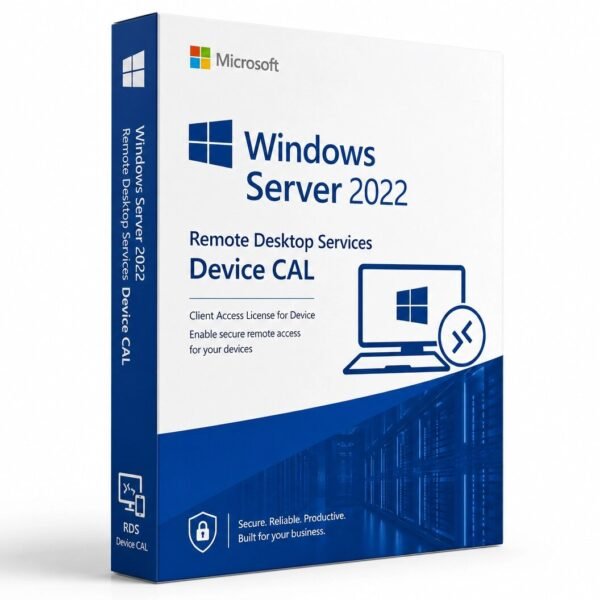
Reviews
There are no reviews yet