




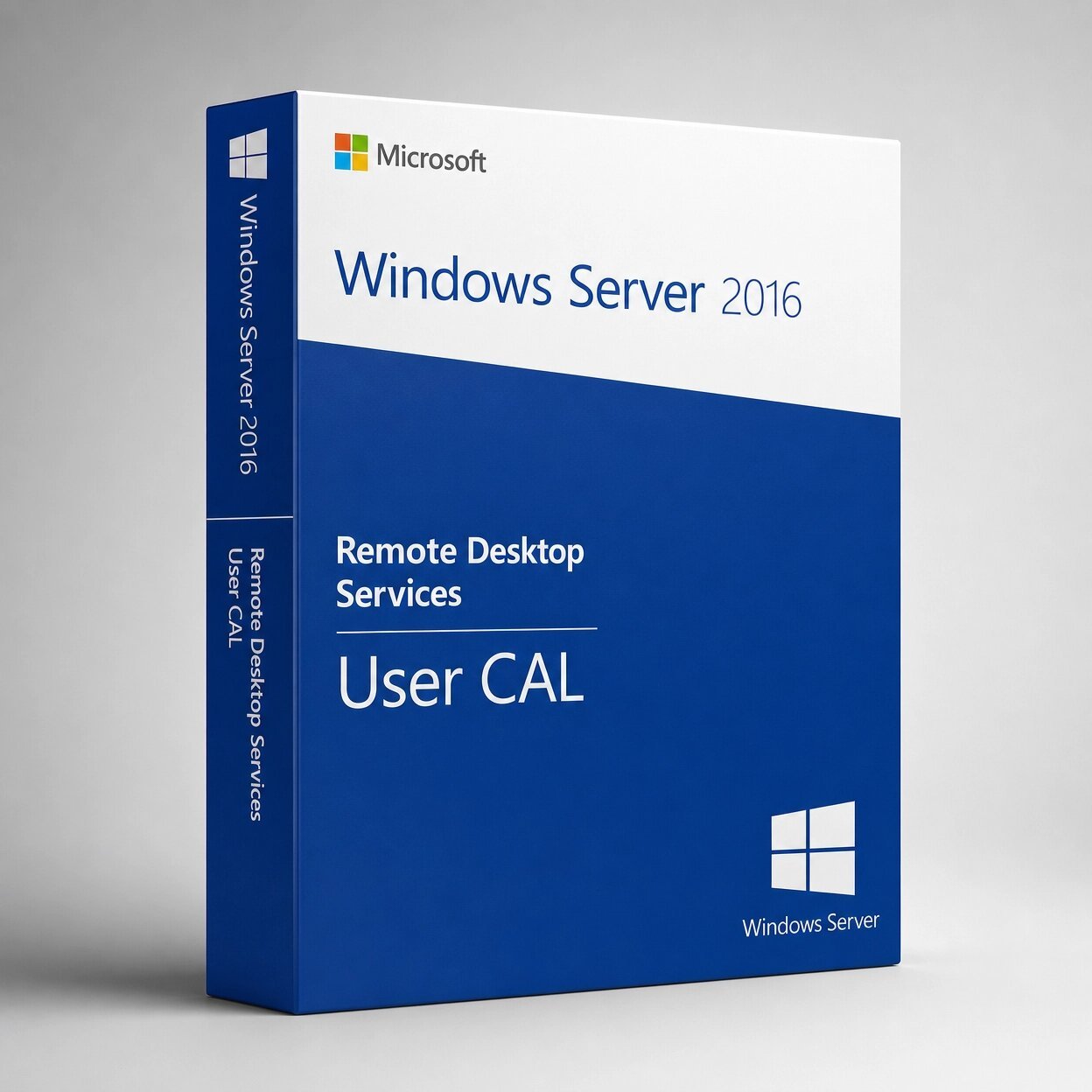
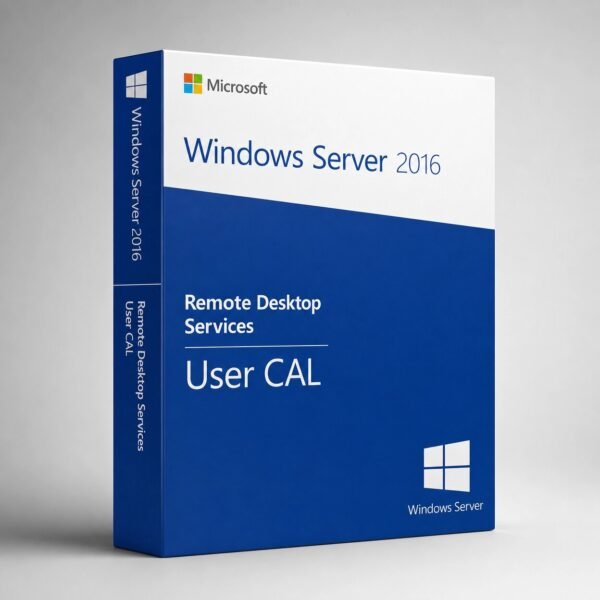
User Windows Server 2016 Remote Desktop Services (RDS) User CAL
CAD $ 63.00
A genuine Microsoft license granting one named user unlimited device access to Windows Server 2016 Remote Desktop Services.
- User-based license one user, unlimited devices
- Full Microsoft licensing compliance for Windows Server 2016 RDS
- Delivery: License key sent by email within minutes
- Lifetime license one payment, forever
- Guarantee: 100% satisfaction & money-back guarantee
Genuine Microsoft license — activated on Microsoft’s own servers
- Instant delivery: your product key, official download link and step-by-step activation guide arrive by email within minutes of payment — 24/7, USA & Canada.
- Lifetime license: pay once, activate forever. No subscription, no renewal fees, no expiry.
- 100% genuine & legal: every key is sourced through authorized supply chains and verified before it reaches your inbox.
- Money-back guarantee: 30-day refund policy plus a lifetime activation warranty — if a key ever fails, we replace it free.
- Secure checkout: Visa, Mastercard, Apple Pay, Google Pay, PayPal and Interac e-Transfer.
- Real human support: licensing and activation help across North American time zones.
How it works: 1) Add to cart and pay securely → 2) Check your inbox for the key and download link → 3) Install and activate with the included guide. Need help? See our activation guides or contact us.
Windows Server 2016 Remote Desktop Services (RDS) User CAL – Genuine License
Buy Windows Server 2016 RDS User CAL | Fast Email Delivery | USA & Canada
A Windows Server 2016 Remote Desktop Services User CAL (Client Access License) is the Microsoft-required license that legally entitles a named individual to connect to Remote Desktop Services on a Windows Server 2016 host — from any device, from any location, as many times as needed.
If your organization uses Remote Desktop Services to deliver hosted desktops, published applications, or centralized remote access on Windows Server 2016, every user who connects requires both a base Windows Server 2016 User or Device CAL and a Windows Server 2016 RDS User CAL. The RDS User CAL is the additional license that specifically covers the Remote Desktop Services session it is a legal requirement enforced during Microsoft licensing audits and cannot be substituted with any other license type.
The license key delivered by MMKeys is a genuine Microsoft RDS User CAL for Windows Server 2016, delivered to your email inbox within minutes of purchase, backed by our lifetime warranty and money-back guarantee.
What Is a Windows Server 2016 RDS User CAL?
Remote Desktop Services is the Windows Server role that enables multiple users to connect simultaneously to a Windows Server 2016 host and run applications or full desktop sessions in a centralized, server-hosted environment. It is the platform behind virtual desktop infrastructure, remote application delivery, work-from-home access to corporate applications, thin-client computing environments, and branch office connectivity to centralized server resources.
Microsoft licenses access to Remote Desktop Services through Client Access Licenses. Without valid RDS CALs installed and issued through an RDS License Server, Windows Server 2016 operates in a grace period of 120 days before Remote Desktop Services begins refusing connections from users beyond the two built-in administrative sessions that are always available for server management purposes.
A User CAL licenses a specific individual not a device. One Windows Server 2016 RDS User CAL covers a single named user connecting to Remote Desktop Services from any number of devices: their office workstation, their home computer, their laptop, their tablet, or any other endpoint they connect from. There is no limit on how many devices that licensed user may connect from, and no limit on how many simultaneous sessions that user may hold across those devices at any given time.
This makes the User CAL the correct and most cost-effective choice for any user who accesses Remote Desktop Services from more than one device which describes the majority of remote workers, hybrid employees, and flexible workers in modern organizations of all sizes.
What Is Remote Desktop Services and Why Does It Require CALs?
Remote Desktop Services in Windows Server 2016 is built around several integrated role services that together deliver a complete remote access and application delivery infrastructure for organizations deploying centralized computing environments.
The Remote Desktop Session Host is the core role service that hosts the actual user desktop sessions and published RemoteApp application sessions that client devices connect to. Session Host servers are where applications execute and where user sessions are maintained they are the shared compute resources that multiple users access simultaneously, and they are the servers for which RDS CALs are specifically required. Each simultaneous user session on a Session Host consumes server compute resources and represents a separate user access that must be covered by a valid User CAL or Device CAL.
The Remote Desktop Connection Broker manages user connections across multiple Session Host servers in a Session Host farm directing new connections to the least-loaded available Session Host, reconnecting users to their existing disconnected sessions when they reconnect after an interruption, and providing the session management intelligence that makes multi-server RDS deployments function as a unified service. Connection Broker is a required component in production deployments with more than one Session Host server and is the component that enables RDS deployments to scale out by adding additional Session Host servers.
The Remote Desktop Gateway provides secure external access to internal Remote Desktop Services resources from outside the corporate network enabling remote and mobile users to connect to Session Hosts, published RemoteApp applications, and session desktops over HTTPS without requiring a traditional VPN connection on the remote device. RD Gateway is the component that makes work-from-home RDS access practical for organizations that cannot or prefer not to deploy VPN infrastructure for every remote user needing access to corporate applications.
The Remote Desktop Web Access role provides a browser-based portal where users can access their published RemoteApp applications and session desktops from any browser or from the Remote Desktop client — presenting the available remote resources in a web interface that is accessible without client-side configuration beyond installing the standard Remote Desktop client.
The Remote Desktop Licensing role manages and issues CAL tokens to connecting users and tracks User CAL consumption against the installed CAL inventory on the License Server. In a Per User licensing model, the License Server tracks which users have been issued CAL tokens and how many CALs remain available in the installed inventory. A License Server must be reachable by Session Hosts for CALs to be issued without a reachable License Server issuing CALs, Remote Desktop Services enters and eventually exhausts its grace period and stops accepting connections beyond the two administrative sessions.
Microsoft requires RDS CALs because Remote Desktop Services enables shared server-based computing where many users simultaneously run applications on a single server a fundamentally different model from each user running applications on their own dedicated device. The CAL represents the per-user access right that Microsoft requires for this shared computing model.
RDS User CAL vs. RDS Device CAL Which Do You Need?
Windows Server 2016 Remote Desktop Services can be licensed either per user or per device. The two CAL types cannot be mixed on the same RDS License Server an organization must select one licensing model for a given RDS deployment and apply it consistently across all Session Hosts pointed to that License Server.
RDS User CAL licenses a named individual. That person may connect to Remote Desktop Services from any number of devices. One CAL per person, regardless of how many endpoints they use to connect.
This is the right choice for remote workers who connect from both home and office devices, employees who carry laptops and also use office workstations or shared conference room PCs, mobile workers who connect from multiple locations and device types, and any environment where users are more mobile than the devices they use or where the total number of users needing RDS access is smaller than the total number of devices from which connections originate across the organization.
RDS Device CAL licenses a specific physical device. Any number of users may connect from that licensed device. One CAL per endpoint, regardless of how many people share it across shifts or sessions.
This is the right choice for shared workstations in call centers, kiosk terminals, reception desks, manufacturing floor stations, classroom computers, and clinical workstations environments where multiple users take turns using the same physical machine and where the number of devices is smaller than the number of users who need RDS access.
The practical decision rule: count the total number of users who need RDS access and count the total number of devices from which RDS connections will originate. License whichever number is smaller to minimize your total CAL investment. For most organizations with remote workers, hybrid working arrangements, and employees who use multiple devices, User CALs are the more cost-effective and operationally simpler licensing model. For shared terminal, kiosk, and shift-work environments, Device CALs are typically more economical.
What Is New in Windows Server 2016 RDS
Windows Server 2016 Remote Desktop Services delivers meaningful advances over Windows Server 2012 R2 RDS across security architecture, session performance, personal desktop delivery, graphics acceleration, and management — all of which remain fully operational and relevant in Windows Server 2016 RDS deployments today.
Personal Session Desktops
Windows Server 2016 RDS introduces Personal Session Desktops a new session desktop type that assigns individual users a dedicated, persistent personal session desktop on a Session Host server. Personal Session Desktops provide a full Windows desktop experience that persists between sessions and belongs to the individual user, combining the managed infrastructure and centralized hosting of RDS with the personalized desktop experience that users previously only had on dedicated physical workstations or full VDI virtual machines.
Unlike traditional RDS pooled session desktops where users receive a generic session desktop that resets between sessions, Personal Session Desktops retain user customizations, locally installed per-user applications, and user-specific desktop configurations across sessions.
For users who need a persistent, personalized Windows desktop delivered through RDS infrastructure without the per-user VM overhead of full VDI, Personal Session Desktops in Windows Server 2016 provide the right balance of personalization and infrastructure efficiency. Personal Session Desktops are accessed through the same RDS connection infrastructure as pooled session desktops and require RDS User CALs for every assigned user.
OpenGL and OpenCL Application Support
Windows Server 2016 RDS adds support for OpenGL and OpenCL applications in Remote Desktop Services sessions enabling GPU-accelerated graphics applications, scientific computing applications, computer-aided design tools, visualization software, and other GPU-dependent workloads to run in RDS sessions on Session Host servers equipped with compatible GPUs. Previous Windows Server RDS versions did not support OpenGL and OpenCL applications in sessions, limiting RDS to CPU-rendered graphics workloads and requiring separate VDI or physical workstation infrastructure for GPU-dependent applications.
For organizations where users need access to applications that depend on OpenGL or OpenCL engineering applications, design tools, scientific software, data visualization platforms Windows Server 2016 RDS User CALs cover those sessions on appropriately equipped Session Host servers, extending the scope of workloads that can be delivered through the RDS infrastructure without requiring dedicated per-user GPU hardware.
RemoteFX Improvements
RemoteFX in Windows Server 2016 RDS delivers improved graphics rendering and compression for Remote Desktop sessions, providing better visual quality and reduced bandwidth consumption for graphically demanding applications running in RDS sessions.
RemoteFX adaptive graphics in Windows Server 2016 automatically adjusts rendering quality and compression based on available bandwidth and session characteristics delivering the best achievable visual experience within the available network capacity without requiring manual configuration per session or per user.
Virtualization-Based Security for RDS Infrastructure
Windows Server 2016 introduces Virtualization-Based Security across the server platform, and this security architecture directly benefits RDS Session Host servers. Credential Guard on VBS-enabled Session Host servers protects domain credential material NTLM hashes and Kerberos tickets from extraction from Session Host memory, even if an attacker achieves kernel-level access to the Session Host.
In RDS environments where multiple users are simultaneously authenticated on the same Session Host, protecting each user’s credential material from theft by other session users, by malicious processes running in other sessions, or by attackers who compromise Session Host kernel-level access is a meaningful security improvement that Windows Server 2016 delivers at the platform level without requiring changes to the RDS session configuration.
RDS Deployment with Azure Site Recovery
Windows Server 2016 RDS integrates with Azure Site Recovery for disaster recovery of RDS infrastructure enabling RDS Session Host servers, Connection Broker servers, and Gateway servers to be replicated to Azure as warm standby instances that can be brought online in Azure in the event of an on-premises datacenter failure.
For organizations running Windows Server 2016 RDS as a critical business infrastructure service where downtime directly impacts productivity, Azure Site Recovery integration provides cloud-hosted disaster recovery without requiring a second on-premises RDS infrastructure at a DR site.
Windows Server 2016 Security Improvements Benefiting RDS
Windows Server 2016’s platform-wide security improvements benefit RDS deployments specifically. SMB1 can be disabled on Windows Server 2016 Session Hosts removing the most commonly exploited file sharing vulnerability from the RDS infrastructure.
The default TLS configuration is improved across server roles including Remote Desktop Services, with TLS 1.2 as the default protocol version and stronger cipher suite defaults. Windows Defender is enabled by default on Windows Server 2016 Session Hosts, providing baseline malware protection for the Session Host environment without requiring separate antivirus deployment.
For RDS deployments where Session Hosts are externally accessible through Remote Desktop Gateway, these default security improvements in Windows Server 2016 reduce the attack surface of the RDS infrastructure compared to Windows Server 2012 R2, without requiring post-installation security configuration.
Connection Broker High Availability Improvements
Remote Desktop Connection Broker high availability in Windows Server 2016 is improved with better SQL Server Always On Availability Group support for the Connection Broker database, enabling more resilient Connection Broker deployments where the Connection Broker database is replicated to secondary SQL Server instances for high availability.
For production RDS deployments where Connection Broker availability directly affects all users’ ability to connect to Remote Desktop Services, the improved SQL Server HA integration in Windows Server 2016 provides more reliable Connection Broker infrastructure.
Who Needs Windows Server 2016 RDS User CALs?
Organizations running Windows Server 2016 RDS for application or desktop delivery any business using Remote Desktop Session Host on Windows Server 2016 to deliver hosted desktops, Personal Session Desktops, or RemoteApp published applications to end users requires RDS CALs. User CALs are the correct model when users connect from multiple devices or when the total user count is smaller than the total device count.
Businesses with remote and hybrid workers on Windows Server 2016 RDS organizations where employees work from home part or all of the time and connect to corporate applications and desktops hosted on Windows Server 2016 Session Hosts via Remote Desktop require RDS User CALs for every person who connects. The User CAL model is particularly well-suited to hybrid workers who connect from both home computers and office workstations one User CAL covers both connection scenarios for the same person.
Organizations upgrading from Windows Server 2012 R2 RDS RDS CALs are version-specific. Organizations that have upgraded or are upgrading their RDS Session Host servers from Windows Server 2012 R2 to Windows Server 2016 must acquire Windows Server 2016 RDS User CALs for all connecting users. Windows Server 2012 R2 RDS User CALs are not valid for connections to Windows Server 2016 RDS Session Hosts.
IT departments maintaining Windows Server 2016 RDS infrastructure through extended support organizations that have made the operational decision to maintain their Windows Server 2016 RDS infrastructure through the extended support period ending January 2027, who need to ensure full CAL compliance for all users connecting to Windows Server 2016 Session Hosts throughout that period.
Thin-client environments where users roam between devices organizations that have deployed thin-client hardware where users access all their computing through Remote Desktop Services sessions on Windows Server 2016 Session Hosts, and where individual users move between thin-client devices at different workstations or locations throughout the workday. User CALs cover each individual user regardless of which thin-client device they connect from at any given time.
Healthcare organizations using Windows Server 2016 RDS for clinical applications hospitals, clinics, and healthcare networks where clinical staff access electronic health records, clinical imaging systems, and healthcare management applications through Remote Desktop Services on Windows Server 2016, connecting from a variety of clinical workstations and access devices. User CALs license each clinician regardless of how many clinical devices they connect from during their shift.
Professional services firms with mobile professionals law firms, accounting practices, financial advisory firms, engineering consultancies, and other professional services organizations where professionals access document management systems, practice management software, and professional applications through Remote Desktop Services on Windows Server 2016, frequently connecting from both office workstations and personal laptops or home computers. User CALs cover each professional across all their connection devices.
MSPs managing Windows Server 2016 RDS for clients managed service providers that deploy and manage Windows Server 2016 Remote Desktop Services environments for client organizations need to ensure that every end user accessing those environments is covered by a valid Windows Server 2016 RDS User CAL. Licensing compliance is a client obligation that MSPs must plan for and communicate clearly in their service agreements.
Licensing Note What CALs Are Required for RDS
Running Remote Desktop Services on Windows Server 2016 legally requires two separate CAL types for every connecting user, both purchased separately from the server operating system license.
Windows Server 2016 User CAL the base access license required for any user accessing any service on a Windows Server 2016 server, regardless of whether Remote Desktop Services is involved. This covers general server access and is required for every user connecting to Windows Server 2016 for any purpose.
Note that Windows Server 2019, 2022, and 2025 User CALs are backward-compatible with Windows Server 2016 access if your organization has already purchased newer CAL versions, separate 2016 base User CALs are not required.
Windows Server 2016 RDS User CAL the additional Remote Desktop Services-specific license required on top of the base User CAL, specifically for users accessing Remote Desktop Services sessions on Windows Server 2016 Session Hosts. This is what the license from MMKeys provides. RDS CALs are version-specific:
newer RDS CAL versions are not backward-compatible with older RDS host versions in the same way that base Windows Server CALs are. Windows Server 2016 RDS User CALs are required for Windows Server 2016 RDS host access.
Both CAL types are required simultaneously. The RDS User CAL does not replace the base Windows Server 2016 User CAL — it adds to it. The server OS license covers the server. The base User CAL covers general server access. The RDS User CAL covers the Remote Desktop Services session specifically.
RDS CALs are managed and tracked by an RDS License Server role installed on a Windows Server in the environment. The License Server issues CAL tokens to connecting users and tracks User CAL consumption against the installed CAL inventory. Deploying an RDS License Server and configuring your Session Hosts to point to it is a required step in any compliant Windows Server 2016 RDS deployment.
Key Details at a Glance
- License type: Windows Server 2016 Remote Desktop Services User CAL
- Per-user coverage: One CAL licenses one named user to connect from any number of devices
- Version compatibility: Valid for Windows Server 2016 RDS; backward-compatible with older RDS versions
- CAL model: User CAL licenses the person, not the device
- Additional requirement: Base Windows Server 2016 User CAL also required per user sold separately; Windows Server 2019, 2022, and 2025 User CALs satisfy the base access requirement for Windows Server 2016
- Grace period without CALs: 120 days from RDS role installation before connections are refused
- License management: Managed via RDS License Server role on Windows Server
- Delivery: Genuine Microsoft license delivered by email within minutes of purchase
- Warranty: Lifetime warranty and money-back guarantee on every MMKeys order
- Support: 24/7 support available
How to Deploy Windows Server 2016 RDS User CALs
Step 1 — Purchase and receive your RDS User CALs. Your license key arrives by email within minutes of payment confirmation at MMKeys. Check your spam folder if it does not appear in your primary inbox.
Step 2 — Install the Remote Desktop Licensing role. On a Windows Server 2016 server in your environment, open Server Manager and add the Remote Desktop Licensing role service under the Remote Desktop Services role. Complete the role installation wizard. This server becomes your RDS License Server for the deployment.
Step 3 — Activate the License Server. Open the Remote Desktop Licensing Manager console from Administrative Tools, right-click your server in the console, and select Activate Server.
Follow the Activate Server Wizard online activation completes in seconds with an internet connection; telephone activation is available for environments without internet access. The License Server must be activated before RDS CALs can be installed.
Step 4 — Install your RDS User CALs. In the Remote Desktop Licensing Manager, right-click your activated License Server and select Install Licenses. Enter your license key from MMKeys when prompted, select Windows Server 2016 as the product version, select RDS Per User CAL as the license program type, and complete the installation wizard. The specified number of User CALs is now added to your License Server inventory and available for issuance to connecting users.
Step 5 — Configure Session Hosts to use your License Server. On each Windows Server 2016 RDS Session Host, open Group Policy Editor or Local Group Policy Editor and navigate to Computer Configuration > Administrative Templates > Windows Components > Remote Desktop Services > Remote Desktop Session Host > Licensing. Enable the Use the specified Remote Desktop license servers policy and enter your License Server address or hostname.
Enable the Set the Remote Desktop licensing mode policy and set the mode to Per User. Apply the Group Policy settings and verify connectivity between the Session Host and the License Server.
Step 6 — Verify CAL issuance. Open Remote Desktop Licensing Diagnoser on each Session Host it is accessible from the Tools menu in Server Manager to confirm that the Session Host can reach the License Server, that the licensing mode is correctly set to Per User, and that no warnings or errors are reported.
When users connect to the Session Host for the first time after CAL installation, they are issued User CAL tokens that are tracked by the License Server. Monitor CAL consumption in the Remote Desktop Licensing Manager console to track usage against your installed CAL inventory.
Full step-by-step deployment and activation instructions are included with every MMKeys order. Our support team is available 24 hours a day, 7 days a week if you need assistance at any stage.
Is this a genuine Windows Server 2016 RDS User CAL?
Yes. Every license sold by MMKeys is an authentic Microsoft product license. There are no shared keys, workarounds, or grey-market codes. Your RDS User CAL installs and activates through Microsoft's official Remote Desktop Licensing infrastructure.
Do I need both a base Windows Server CAL and an RDS User CAL?
Yes. Both are required. The Windows Server 2016 User CAL covers general server access for each user. The RDS User CAL covers the Remote Desktop Services session specifically. Both must be in place for every user connecting via RDS. The base Windows Server 2016 User CAL is available separately at MMKeys. Note that Windows Server 2019, 2022, and 2025 User CALs are backward-compatible and satisfy the base access CAL requirement for Windows Server 2016 if your organization has already purchased newer base CAL versions, you do not need separate 2016 base CALs.
How many devices can one RDS User CAL cover?
Unlimited. A User CAL licenses a specific named individual, and that person may connect from any number of devices home computer, office workstation, laptop, tablet, thin client, or any other endpoint. There is no device limit associated with a single User CAL.
Can I use Windows Server 2012 R2 RDS CALs for Windows Server 2016?
No. RDS CALs are version-specific. Windows Server 2012 R2 RDS User CALs are not valid for connections to a Windows Server 2016 RDS Session Host. You must purchase Windows Server 2016 RDS User CALs for users connecting to Windows Server 2016 RDS. Windows Server 2016 RDS User CALs are backward-compatible with older RDS host versions including Windows Server 2012 R2.
Are Windows Server 2016 RDS CALs valid for Windows Server 2019, 2022, or 2025 RDS hosts?
No. RDS CALs are version-specific and must match the version of the RDS Session Host server. Windows Server 2016 RDS User CALs are valid for Windows Server 2016 RDS Session Hosts and are backward-compatible with older versions. If you upgrade your Session Hosts to Windows Server 2019, 2022, or 2025, you must purchase the corresponding version of RDS User CALs for those upgraded hosts.
What happens if I run RDS without CALs?
Windows Server 2016 provides a 120-day grace period after RDS role installation during which connections are allowed without CALs. After the grace period expires, Remote Desktop Services begins refusing user connections beyond the two built-in administrative sessions. Microsoft licensing audits identify CAL non-compliance independently of the technical enforcement mechanism, and non-compliance can result in significant licensing penalties during a Microsoft audit.
Should I choose User CALs or Device CALs?
Count the total number of users who need RDS access and count the total number of devices from which RDS connections will originate. License whichever number is smaller. User CALs are the right choice when users connect from multiple devices, when the number of users is smaller than the device count, or when per-user licensing is operationally simpler to manage. Device CALs are the right choice for shared workstations, kiosk terminals, call center environments, and shift-work situations where multiple users share fewer devices. The two models cannot be mixed on the same RDS License Server.
Are Windows Server 2016 RDS CALs the same as Azure Virtual Desktop licenses?
No. Azure Virtual Desktop uses a separate licensing model based on Microsoft 365 or Windows per-user subscriptions. Windows Server 2016 RDS User CALs apply specifically to on-premises or hosted Remote Desktop Services deployments running on Windows Server 2016 Session Hosts. If you are deploying Azure Virtual Desktop in Azure rather than on-premises RDS, consult Microsoft's AVD licensing requirements separately.
How soon will I receive my CALs after purchase?
Most MMKeys orders are delivered within minutes of payment confirmation, 24 hours a day, 7 days a week. Your email includes the license key and complete activation and deployment instructions.
What if my key does not activate?
Contact MMKeys support at any time. Every license is backed by our lifetime warranty and money-back guarantee. If your key does not activate for any reason, we will resolve the issue or provide a replacement at no cost. CONTACT US
25 reviews for User Windows Server 2016 Remote Desktop Services (RDS) User CAL
You May Be Interested In…


Needed user CALs for our remote bookkeeping staff who each use a couple different devices depending on the day. Installation was smooth, license server picked up the new CALs immediately, and our compliance audit came back clean afterward.
Genuine keys, activated without issue. Only reason for four stars is the deployment steps assume some familiarity with the Remote Desktop Licensing Manager console, which took me a bit of reading to get right the first time. Support helped when I got stuck.
Straightforward transaction from start to finish. Key delivered within minutes, installed onto our license server without errors, confirmed active through the diagnoser. Covers our growing remote workforce nicely.
Our attorneys work from the office, home, and occasionally from court so they’re constantly switching devices. Per-user licensing made far more sense than tracking device CALs for the same person across three different machines.
Our financial advisory firm has staff who split time between the office and working from home, often within the same week. One user CAL per advisor covers all their devices, which simplified our licensing significantly compared to before.